Stand-mount · 1.5–3 m
Tikpal Reference
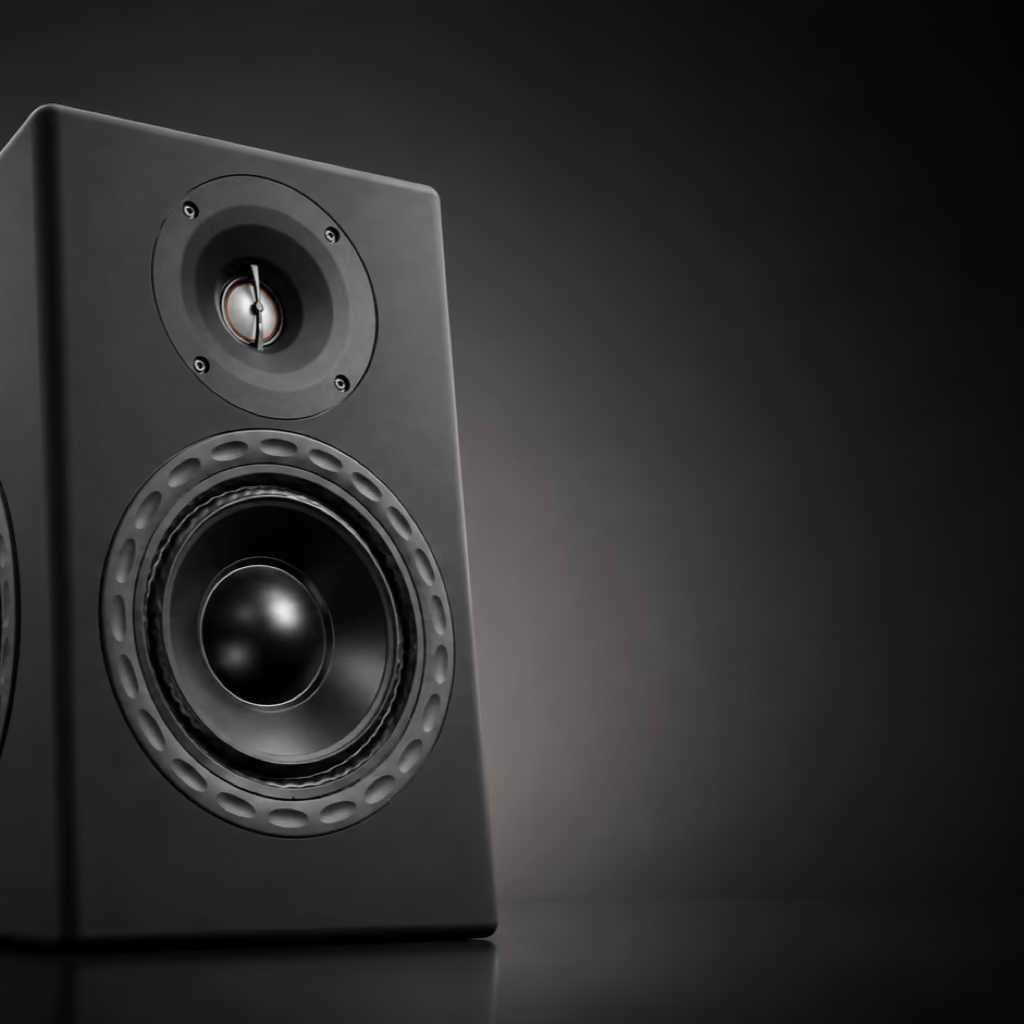
Prototype ValidationOur flagship stand-mount two-way — a waveguide-loaded tweeter and a long-throw mid-bass driver, engineered around measured directivity.
Part of Tikpal Room · Engineered by Tikpal Audio
Where it lives
Stand-mount · 1.5–3 m
Built for dedicated stands and the listening chair. Sit 1.5 to 3 metres away; the waveguide keeps the listening window wide enough that toe-in becomes a matter of taste, not correction.
-
Stable from any seat
Waveguide-controlled directivity through the crossover region keeps the spectral balance the room delivers — early reflections stay neutral, so the sound holds together off-axis.
-
Real extension from a stand-mount
A long-throw 6.5-inch mid-bass in a tuned enclosure reaches a provisional 42 Hz at -6 dB — usable bass without a subwoofer.
-
Every claim has a graph
On-axis response, horizontal directivity and the prototype A/B comparison are published in the measurement archive, each labelled with its evidence level.
Structure & waveguide
Structure & waveguide close-up photography is in preparation
Structure & waveguide close-up photography is in preparation
The measurements
What the measurements say
The first datasets are published and clearly labelled as sample data — they reflect our current simulation and bench targets. Verified bench measurements replace them before pre-orders open.
Specifications
Specifications are provisional
| Format | Two-way passive stand-mount |
|---|---|
| Drivers | 6.5" aluminium-cone mid-bass, 1" soft-dome tweeter on waveguide |
| Crossover | Passive, 2.4 kHz Linkwitz–Riley target (provisional) |
| Frequency range | 42 Hz – 22 kHz (provisional, -6 dB) |
| Sensitivity | ~86 dB / 2.83 V / 1 m (provisional) |
| Impedance | 8 Ω nominal, 5.8 Ω minimum (provisional) |
Development log
- Waveguide-controlled directivity through the crossover region for a stable power response.
- Prototypes A and B built and measured to quantify what the waveguide actually changes.
- Long-throw mid-bass driver in a tuned enclosure for usable extension from a stand-mount.
- Crossover parts values published once finalised — tuning is done in the measurement domain, not by ear alone.
The goal
A stand-mount two-way whose off-axis behaviour is engineered rather than accepted. Most speakers are designed to measure flat on one axis; Tikpal Reference starts from the listening window — the bundle of reflections and direct sound that actually reaches you — and works backwards to the drivers.
Design notes
The tweeter sits at the throat of a round waveguide whose flare rate was chosen to match the mid-bass unit’s directivity near the crossover. When the two drivers hand over to each other with matched directivity, the room keeps receiving the same spectral balance at every angle — early reflections stay neutral, and the speaker becomes less picky about toe-in and room treatment.
Two full prototypes exist. Prototype A carried an early crossover; Prototype B added corrected tweeter loading and a revised crossover. The comparison is published in the measurement archive so you can see what changed and why.
What we measured
On-axis frequency response, horizontal directivity and the A/B prototype comparison are available in the measurement archive. These first datasets are clearly labelled sample data — they reflect our current simulation and bench targets, and will be replaced by verified bench measurements before pre-orders open. See Methodology for how we classify data.
Stay close to this build
Status changes here first — the button below tracks it automatically.